 Independent visitor guide to Tay Ninh province

Destinations · Cao Dai Holy See
The Cao Dai Holy See: ceremonies, galleries and manners
The mother temple of Caodaism, a faith founded in Tay Ninh in 1926, holds a ceremony four times a day. Visitors are welcome to watch from the galleries above the nave. The rules are simple; the timing and the dress code are where visits go wrong.
At a glance
- Ceremonies
- 0:00, 6:00, 12:00, 18:00
- Noon ceremony
- About 30 minutes
- Time needed
- 1 to 2 hours
- Where visitors stand
- Upper galleries during ceremonies
- Dress
- Shoulders and knees covered
- From HCMC
- About 96 km, about 2 hours
Sources: Vietnamtourism.com — Cao Dai, inside Vietnam's home-grown religion (commercial guide); VnExpress — Tay Ninh travel handbook (Vietnamese, September 2024) · last checked .
What the Holy See is
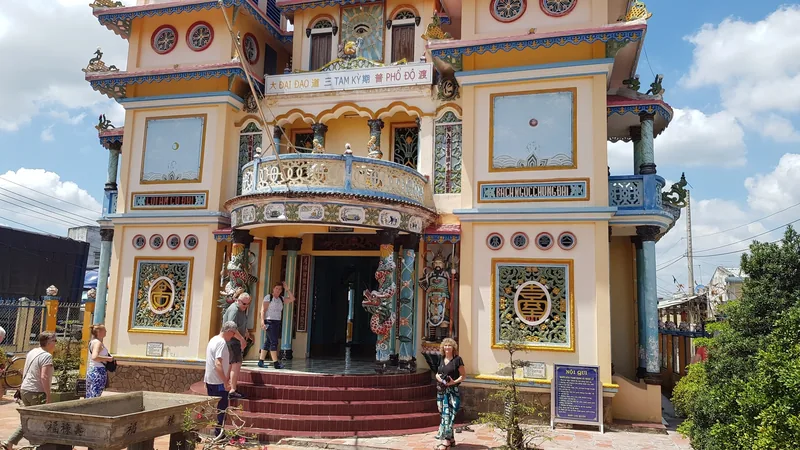
Caodaism was officially founded in 1926 in Tay Ninh, after a series of seances in Saigon and the Mekong Delta. It draws on Buddhism, Confucianism, Taoism and Christianity, and its symbol is the Divine Eye inside a triangle. The Holy See, or Toa Thanh, is its central temple and the seat of its hierarchy. Construction started in 1933; VnExpress dates the completion of the building to 1947 and its inauguration to 1955.
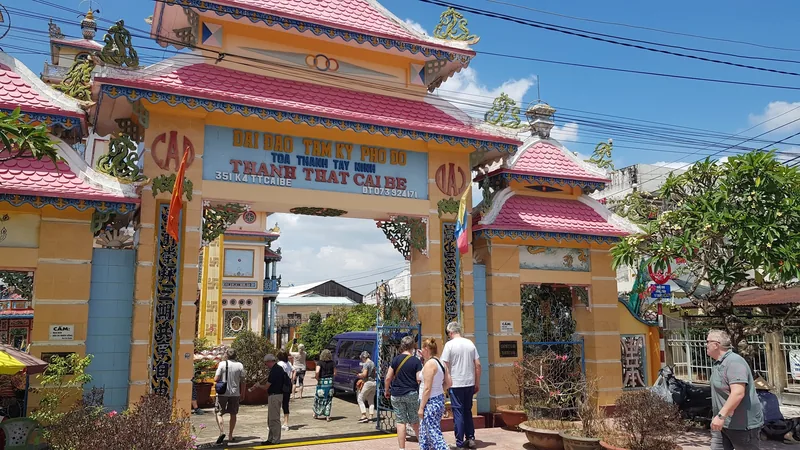
The temple sits inside a large walled compound of gardens, gates and administrative buildings, in what is now Long Hoa ward. That ward was formed in June 2025 from the former Long Thanh Bac and Long Hoa wards and three communes of Hoa Thanh town, which is why older guides give the address as Hoa Thanh. It lies about four to five kilometres from the former provincial town.
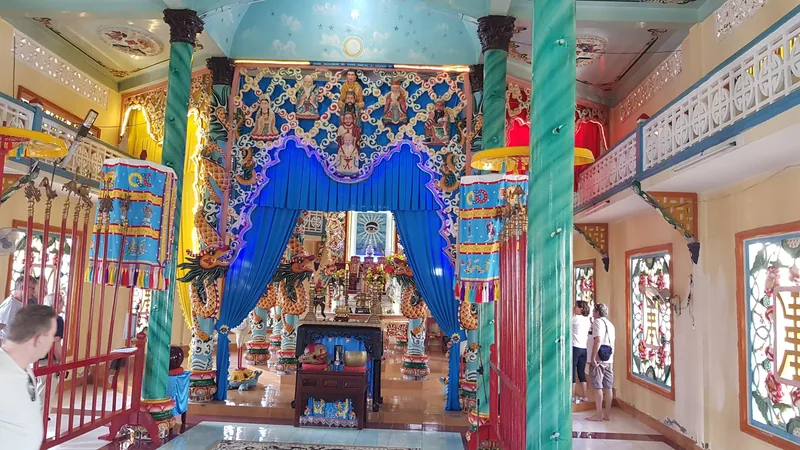
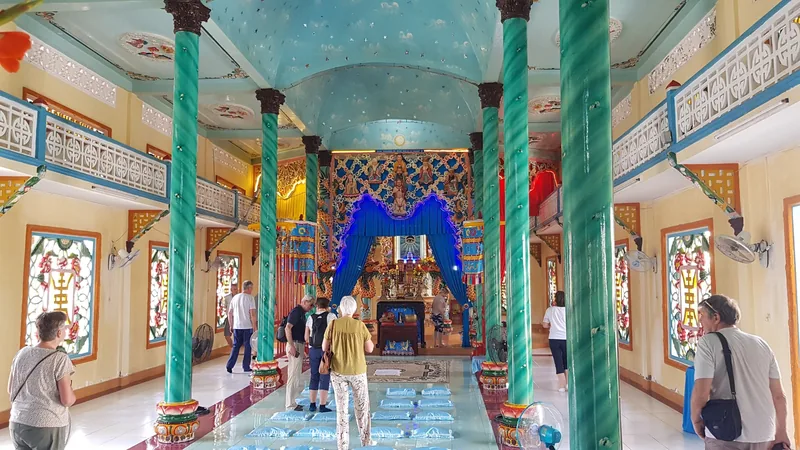
Inside, the nave is lined with columns wrapped in painted dragons, under a ceiling painted as a starry sky. During a ceremony, followers in white robes, and dignitaries in yellow, blue and red, kneel in rows on the floor while musicians and a choir perform from a raised area. The building is a working place of worship, not a museum. That is the reason for most of the rules below.
Sources: Vietnamtourism.com — Cao Dai, inside Vietnam's home-grown religion (commercial guide); VnExpress — Tay Ninh travel handbook (Vietnamese, September 2024); Wikipedia — Long Hoa ward, Tay Ninh; Outlook Traveller — Cao Dai Holy See · last checked .
Ceremony times
| Ceremony | Time | What to expect |
|---|---|---|
| Midnight | 0:00 | Rarely attended by visitors; check access before going |
| Morning | 6:00 | Quieter galleries; pairs well with an early Ba Den visit afterwards |
| Noon | 12:00 | The one most visitors attend; about 30 minutes; galleries busiest |
| Evening | 18:00 | Quieter than noon; useful for an overnight stay |
All sources we checked agree on the four times. The noon ceremony is the one tour groups are built around, and travellers who have been describe the galleries as packed at that hour. Arriving 20 to 30 minutes early gives time to walk round the outside, change into suitable clothes if needed, and find a place at the gallery rail before the procession begins.
One local guide suggests arriving around 7:00 to 7:30 for a calmer visit, when followers are moving through the compound after the morning rites. On the two main festival days the schedule and access change; see below.
Sources: Vietnamtourism.com — Cao Dai, inside Vietnam's home-grown religion (commercial guide); VnExpress — Tay Ninh travel handbook (Vietnamese, September 2024); Giles Orr — Cao Dai Holy See (personal travel blog); Outlook Traveller — Cao Dai Holy See; Sun Paradise Land news — one day at the Cao Dai Holy See · last checked .
Where visitors stand
During ceremonies, visitors stay on the upper galleries that run along both sides of the nave, above the worshippers. You do not go down to the main floor while a ceremony is under way. After it ends, visitors may be allowed onto the floor, and VnExpress notes that you can ask permission to go upstairs for a wider view at other times. Staff direct people at the doors; follow them rather than the crowd.
The galleries are narrow. When a large group arrives, the front row fills quickly, and people at the back see little. If seeing the ceremony matters more than seeing the building, the 6:00 or 18:00 ceremony is the better plan.
Sources: Vietnamtourism.com — Cao Dai, inside Vietnam's home-grown religion (commercial guide); VnExpress — Tay Ninh travel handbook (Vietnamese, September 2024); Giles Orr — Cao Dai Holy See (personal travel blog) · last checked .
Dress, shoes and conduct
- Cover shoulders and knees, for men and women, everywhere in the compound. Shorts and sleeveless tops are the commonest reason visitors are stopped at the door.
- Remove hats and sunglasses inside the temple.
- Keep quiet, walk softly and stay in the areas you are shown.
- Shoes: sources disagree. VnExpress says shoes are removed and watched by staff; another guide says they are worn inside. Wear shoes that come off easily and do what the staff at the door ask on the day.
We could not find a rule published by the Holy See itself on footwear. The two sources we checked give opposite answers. If you have visited recently, the contact page is the place to tell us what you were asked to do.
Sources: Vietnamtourism.com — Cao Dai, inside Vietnam's home-grown religion (commercial guide); VnExpress — Tay Ninh travel handbook (Vietnamese, September 2024); Sun Paradise Land news — one day at the Cao Dai Holy See · last checked .
Photography
Photography from the galleries is generally allowed, without flash. Do not photograph on the main floor during a ceremony, and do not photograph individual worshippers close up without their permission. VnExpress adds that visitors should not photograph the Divine Eye backdrop above the altar, while views of the building are fine. Discreet video is reported to be tolerated; a tripod, a drone or a ring light is not the kind of discretion meant.
Sources: Vietnamtourism.com — Cao Dai, inside Vietnam's home-grown religion (commercial guide); VnExpress — Tay Ninh travel handbook (Vietnamese, September 2024) · last checked .
Festival days
Two festivals bring the largest gatherings. The great feast of the Supreme Being, Dai le via Duc Chi Ton, falls at the start of the first lunar month (VnExpress gives the eighth day). The Hoi Yen Dieu Tri Cung, the feast of the Jasper Pool palace, is held on the fifteenth day of the eighth lunar month. On these days the compound fills with followers from across the south, and the noon routine for visitors may not apply.
If you can choose, avoid them for a first visit focused on the building. If you want to see the faith at its largest, come early and expect to watch from the edge. The first lunar month is also the spring festival at Ba Den, so roads in the area are busy at the same time.
Sources: VnExpress — Tay Ninh travel handbook (Vietnamese, September 2024); Sun Paradise Land news — Ba Den festivals in 2026 · last checked .
Getting there and food nearby
Coaches from Ho Chi Minh City list the Holy See main gate as a drop-off, and the local bus 70-2 from Cu Chi passes it on the way to Ba Den. The temple is about 96 kilometres from the city, roughly two hours in light traffic. Details are on the getting there page.
Many Cao Dai followers eat vegetarian food, and the Long Hoa market in the centre of the ward has a vegetarian food court and stalls selling local products, including vegetarian salt. It is the simplest place to eat between the noon ceremony and the afternoon at Ba Den.
Sources: MoMo — HCMC to Tay Ninh coach tickets (ticket platform); mia.vn — buses to Tay Ninh (retailer travel blog, March 2025); Vietnamtourism.com — Cao Dai, inside Vietnam's home-grown religion (commercial guide); VnExpress — Tay Ninh travel handbook (Vietnamese, September 2024) · last checked .
Pictures

Who should skip it, and when not to go
- Travellers who want an empty building to photograph. The temple is busiest exactly when it is most interesting.
- Anyone unwilling to cover shoulders and knees; you may not get past the door.
- Visitors on the two main festival days who expect the normal visitor routine.
- People who will arrive at 12:15 on a coach day. By then the gallery rail is full and the ceremony half over.
If the noon timing does not fit, an overnight stay lets you see the 18:00 or 6:00 ceremony instead. See day trip or overnight.
Common questions
Questions readers ask
Is there an entry fee at the Holy See?
None of the sources we checked lists one. Confirm on arrival, and do not pay anyone outside the gate who claims to sell entry.
Can I attend the ceremony as a non-believer?
Yes, as an observer from the upper galleries, dressed with shoulders and knees covered.
Do I have to take my shoes off?
Sources disagree. Wear shoes that are easy to remove and follow what the staff ask on the day.
Which ceremony is quietest for visitors?
The 6:00 and 18:00 ceremonies. The noon one is the busiest because most day trips are timed for it.
Related
Read next

Destinations · Ba Den Mountain
Ba Den Mountain
Cable car lines, summit, pagodas, opening hours, fares, crowd peaks and when not to go.
Read more
Understand · Planning
Day trip or overnight
Hours needed for Ba Den, the Holy See, Lang Sen and the north, and when a day trip becomes an overnight.
Read more
Understand · Calendar
Festivals and seasons
Ba Den and Cao Dai festival dates, crowd peaks, the dry and rainy seasons, and how to time a visit.
Read more
Understand · Practical
Practical information
Weather, what to wear at temples, money and costs, health and safety for a visit to Tay Ninh.
Read more
Understand · Getting there
Getting there
Coach, local bus and car from Ho Chi Minh City to Tay Ninh, with journey times, fare ranges and pitfalls.
Read more
Destinations
Destinations
The main places in Tay Ninh province compared: hours needed, distance, season and who each suits.
Read moreStart planning
Send a correction or a question
Tell us which page you mean, what you found and when. A link to an official notice or a photo of a fare board helps us check it.